The following pages arise from a two-month experience in Bangladesh, between rural villages and contexts of poverty, in close contact with local people.
I write as a temporary observer, from a European and privileged position: one that allows me, at any moment, to leave.
This is not a story about Bangladesh.
It is a story about what happens when one’s gaze is displaced—when the idea of elsewhere stops being abstract and becomes embodied.
I did not go there to confirm a thesis, nor to extract lessons. Those months did not teach me a truth; they eroded some of my certainties. And it is from that erosion that this diary begins.
Elsewhere was born as a research process, as a conversation. It moves through places and people marked by different forms of displacement—geographical, social, emotional. Migration, faith, poverty, work, relationships, integration: themes that today circulate as slogans or threats, often handled by those who have never had to inhabit them.
What emerges is not a map of destinations, but a recurring question: home.
Not as a fixed place, but as a fragile line that connects desires, fears, identities, and survival strategies. A better place, a better future, a better life: promises that have guided humanity for centuries, and that today appear increasingly unstable as resources shrink and frustration grows.
I write in the first person. I speak for no one and against no one. I do not represent flags, parties, or collective identities. What follows is my experience, with its limits and contradictions.
I believe a healthy society is made of individuals capable of doubt rather than applause; capable of holding contradictions together rather than searching for enemies. If there is a thread running through this work, it is this: the real adversary is not the other, but the fear that pushes us to simplify what is complex.
This diary does not ask for consent.
It asks only not to be simplified. Because elsewhere is not a place we reach, but a tension we inhabit.
The Capybara Mission
Before leaving for Bangladesh, I chose a guide animal: the capybara.
Why the capybara? Because it has a reputation for getting along with everyone. You see it next to turtles, with birds on its back, even sleeping near a caiman. Of course, reality is more complex: even capybaras lose their temper sometimes. But it remains a peaceful, curious animal, capable of coexisting with other species without trying to dominate them.
With a bit of irony, but a lot of inspiration, I took the capybara as a model.
Not to “understand” Bangladesh. Not to explain it, but to make friends.
For the first weeks, I leave my camera in the hostel.
I go out with a notebook, a pen, and a smartphone to use Google Translate between English and Bengali. I wander along the coast, along the highway between Dhaka and Chattogram, stopping at tea places: ten square meters at best, snacks hanging on the walls, and doodh cha—tea with milk and sugar—which I quickly become almost addicted to.
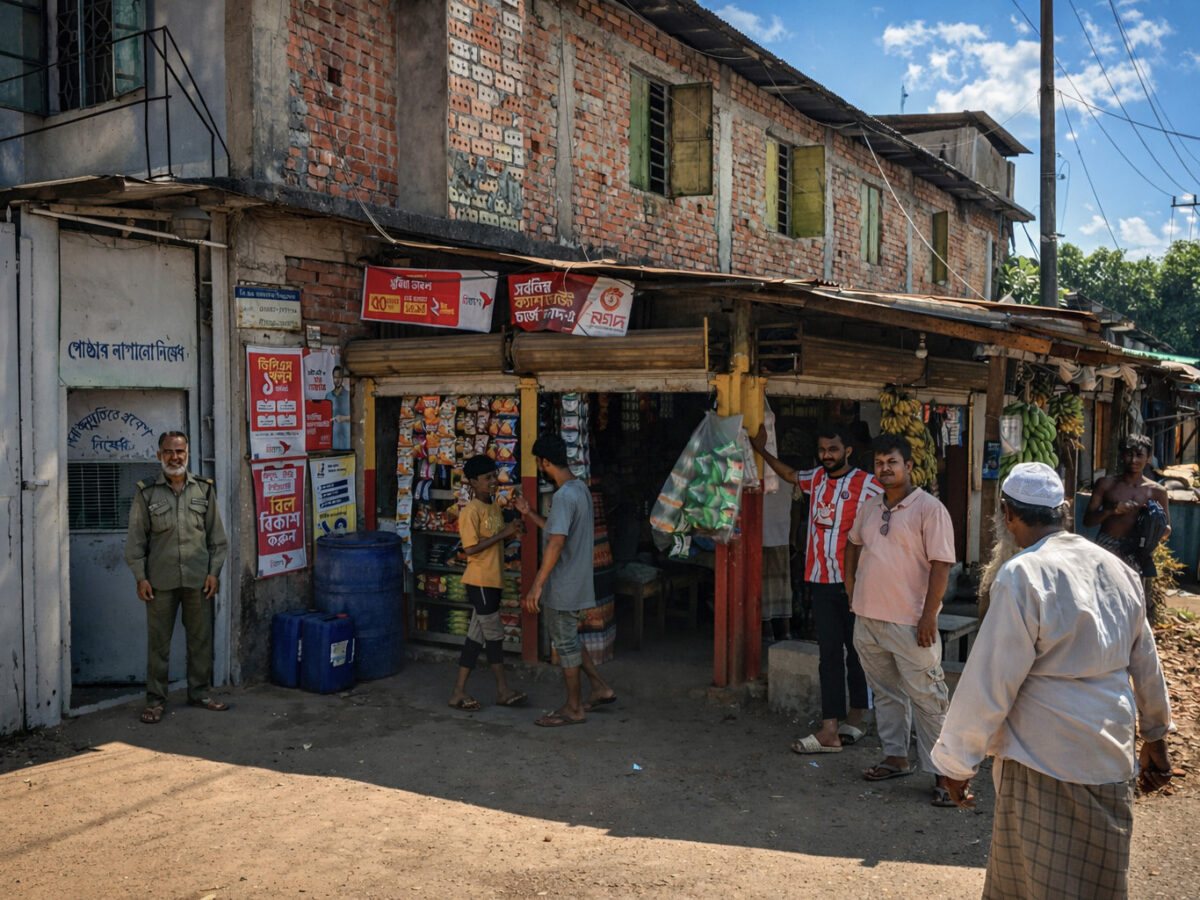
I walk in, greet people in the local language, order a tea, and sit down in the shared silence and collective astonishment.
This white alien radiating whiteness, minding his own business: writing, watching, waiting.
It usually takes two minutes. Someone comes closer. No one speaks English.
And so a slow conversation begins, made of a few carefully chosen words, translated one by one. No rush. No performance. After five minutes, the same spontaneous ritual always starts: a competition of hospitality.
“Come eat at my place.”
“No, today you go to his place, but tomorrow you come to mine.”
Something I haven’t seen in years. Maybe since I was a child, when my grandparents lived more in the street than at home.
So I start returning over the following days, and one by one, I meet families, communities, mosque representatives, imams, influential people in the villages. They see that I’m not a threat. That I come with good intentions. Maybe even that I’m amusing. We exchange phone numbers, take photos together.
The area is not neutral: in the background there is the ship-breaking business—an enormous, dangerous, precarious industry.
I hear stories of journalists who, after just a few days, regularly meet Bangladeshi intelligence. In two months, I never saw a trace of them. Maybe because I’m diligently doing the “homework” for them: by publishing five or six photos a day on local social media accounts of the people I encounter, most likely they always know exactly where I am.

The Capybara Mission began like this. And it lasted for more than half of the journey.
Only after building relationships of trust I take out the camera. And only then I start to photograph and film. Not because it’s the right moment to tell a story. But because, finally, I’m no longer just passing through.
A dish of rice
In Bangladesh I understood that time is not a line, but a threshold.
Each day is oriented toward a simple and absolute goal: making it to the evening with enough taka to bring home a plate of rice. Everything else—appointments, promises, plans, even relationships—is secondary, negotiable, fragile.
This is not disorganization. It is survival.
In the poorest rural villages, time is not planned; it is chased. An unexpected event, a rainstorm, a missed day of work, and priorities shift instantly.
A commitment made yesterday can dissolve today without explanation—not out of disrespect, but because a greater urgency has emerged in the meantime: eating.
As a European, at first this is disorienting. At first, I kept reading everything through the only grammar I knew. I was trained to equate respect with punctuality, continuity, coherence.
It took time to realize that, in that context, presence mattered more than schedules. Not better. Not worse. Just operating on a different axis.
I had to unlearn a great deal in order not to read everything through my own categories. And even then, I did not always succeed.
Perhaps the point is not to decide who is “right,” but to recognize that when survival is a daily condition, time stops being a project and becomes a resource to seize now, immediately.
A plate of rice is not just food.
It is a measure of the world.
Eating with Your Hands
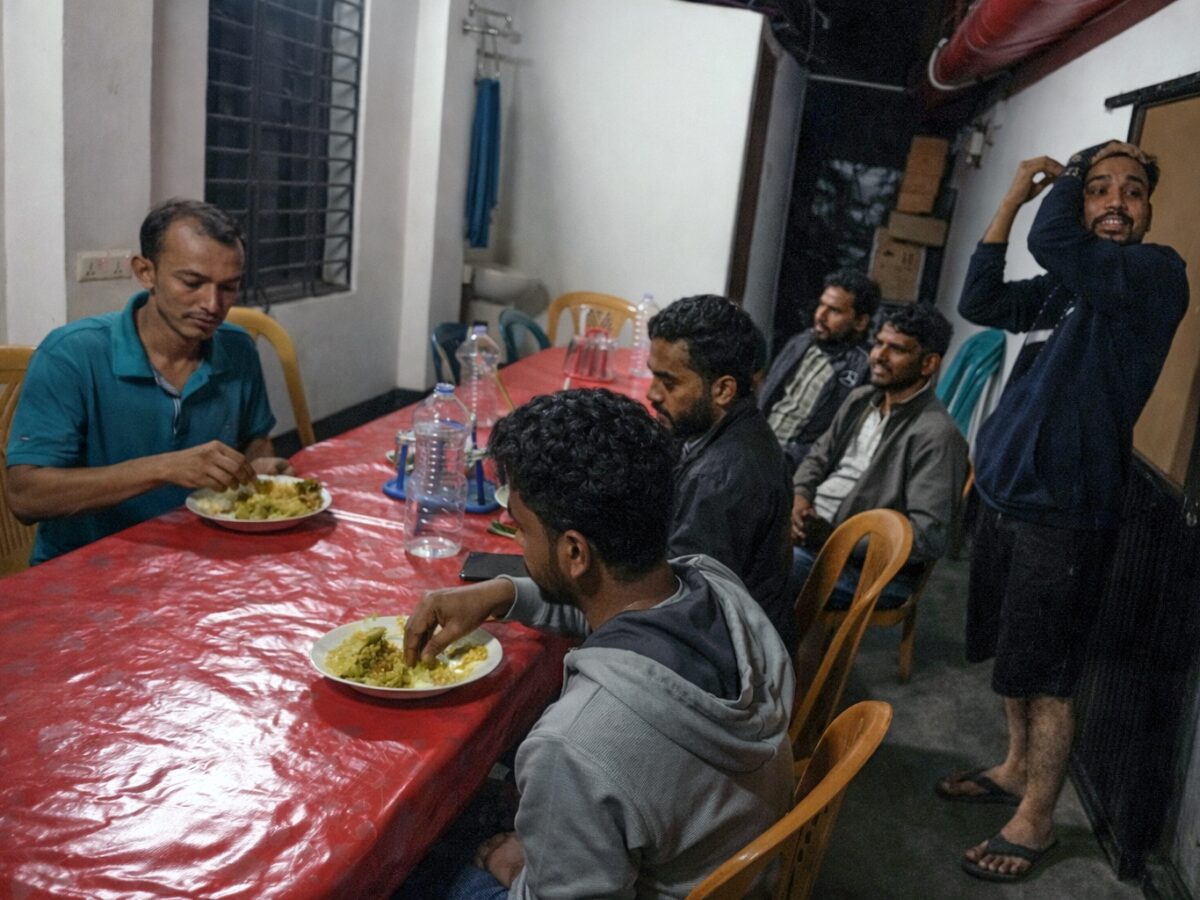
In Bangladesh I ate with my hands for two months, without thinking too much about it.
At first it’s a mental issue: hygiene, habit, control. Then it becomes a bodily one. You wash your hands, use the right one, touch the food, feel its temperature, its texture. The meal begins before it reaches your mouth.
Eating with your hands is not folklore. It is a different way of being in the world. The body takes part; it does not delegate. There is no distance between you and what you are about to eat. You are inside the act, not above it.
I come from a context where mediation is everywhere: cutlery, surfaces, filters, protocols: I noticed how often I use distance as a form of control — with food, with others, with whatever makes us uncomfortable.
During the journey I understood that many of our fears have less to do with safety than with control. Touching means exposing yourself. It means trusting. It means accepting that the world is neither sterile nor fully predictable.
Eating with your hands accelerated relationships. It took time away from words and gave it back to gestures. No one explained what to do. Perhaps it is no coincidence that when survival is immediate, the body stays central.
I realized how much, in my own environment, I tend to intellectualize what could simply be lived.
It is not a matter of right or wrong.
It is a matter of how willing we are to get our hands dirty in order to meet.
It’s Not the Indiana Jones Cobra
One day, in a remote hostel in the Bangladeshi countryside near the coast, I was going down the internal staircase.
I’m about to step onto the ground floor when I see something moving.
I look up and immediately understand what it is.
Not if it’s a snake.
What kind of snake it is.
A cobra.
Not the cinematic Indiana Jones one.
A real one. About a meter long. There. Moving. Looking at me.
I freeze. Luckily it’s more than a meter away.
I call the caretaker, Jakir. A small, bald, very gentle man. He doesn’t speak English.
“Jakir! Jakir!”
He runs over, looks at me, confused.
I look at him and say: “Cobra! Cobra!”
He looks at me.
“Cobra?”
“Yes! Yes!” — and I point in front of me.
Jakir looks at the cobra, which in the meantime starts moving toward him.
Then he looks at me.
And shouts: “COBRA!”
At that point he grabs a rug and tries to throw it over the snake to immobilize it.
I step down the stairs.
For about a minute a surreal scene unfolds: Jakir trying to figure out whether the cobra is under the rug, me watching, the cobra setting the pace.
Then Sarwar arrives.
The only one who speaks English.
The calm of a genie from a lamp.
“What is happening?”
“There’s a cobra under the stairs.”
“Oh. A cobra?”
He asks how big it is. I say about a meter.
“No, no, don’t worry. Even if it bites you, you won’t die. It hurts, but you won’t die.”
And while Jakir keeps searching for the snake, Sarwar crouches down to floor level and starts a local ethology lesson.
He explains the different kinds of snakes in the Bangladeshi countryside, which ones are venomous, which aren’t, how they’re adapting to farmland.
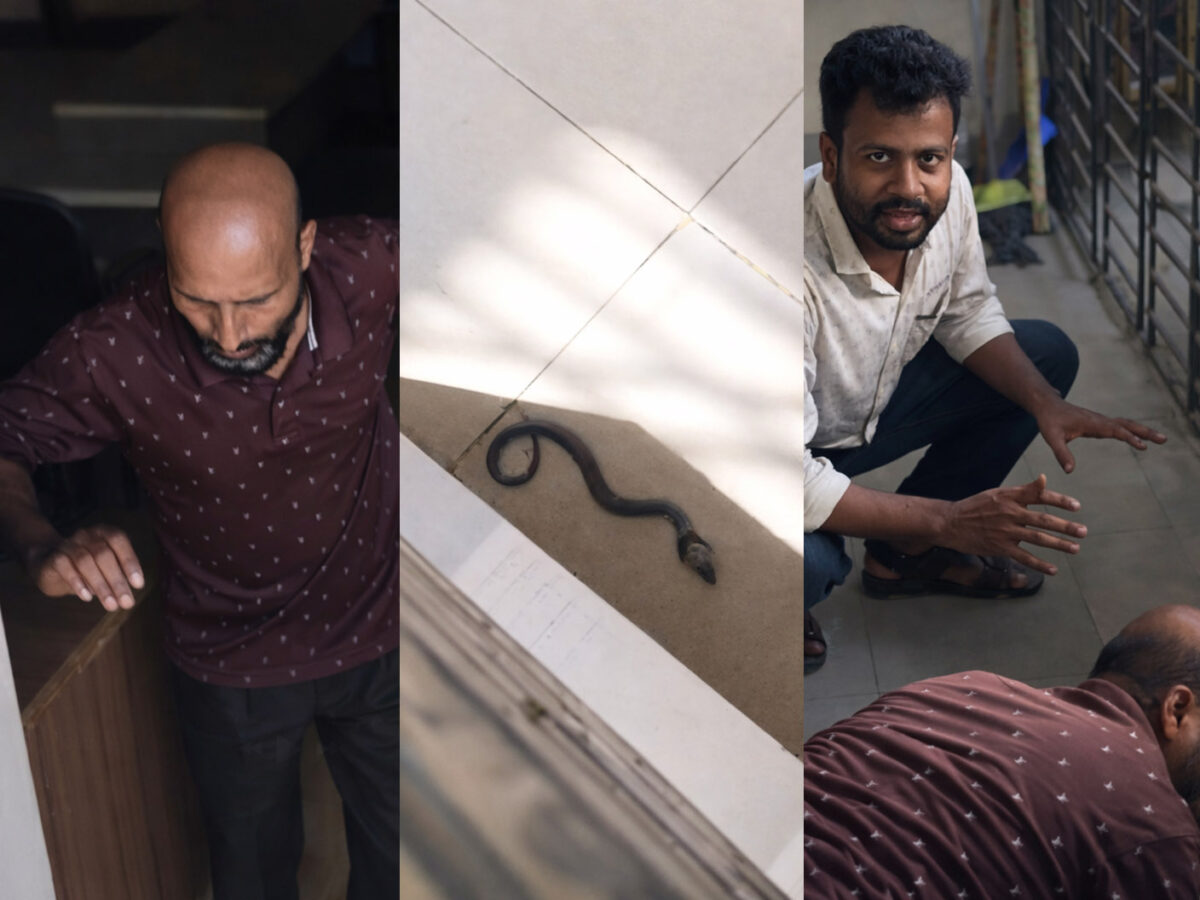
A perfectly balanced mix of: let me explain the wonders of my country, and in the meantime don’t worry too much about the cobra.
I watch the scene amused. I have to go to work, so I leave them there looking for the snake.
That evening, at dinner, I ask:
“And the cobra?”
“Probably it left.”
“I’m not going to find it in my room, right?”
They look at me, relaxed.
“Probably not.”
That’s when I understood something: I come from a place where unpredictability feels like failure. There, unpredictability was simply part of the equation.
The Daughters’ Leftovers
One day, as a guest at the table, I’m still hungry.
Most of the food is gone. On the plate there’s only the leftovers from my collaborator’s daughters. Without thinking too much, I take them and eat them. They’re good. And I’m hungry, full stop.
Some time later he tells me, almost with surprise: “The Europeans I met before you always had issues with food. Hygiene, habits, fears. We could never really share. When I saw you eat even my daughters’ leftovers, I understood that this time it was different.”

For me, there was nothing special about that gesture.
For him, it was a threshold crossed.
Food is not just nourishment. It is trust. It is accepting to share the same space without invisible barriers. I ate with my hands for two months. Not to adapt, but because it felt natural. You wash your hands, you use the right one, you share.
I often speak about integration, dialogue, respect.
That day I noticed how fragile those words can be when they reach the level of a plate, a smell, a texture.
We don’t recognize. So we build distance, even when we say we want to overcome it.
That day I understood something about trust. Not through speeches, but through a gesture that didn’t ask for permission.
Sometimes it’s enough to sit down, eat what’s there, and stop defending your own boundary.
You can learn more about Elsewhere here: https://primipiani.net/elsewhere/
No Problem, I Love You – A selection of photos from Bangladesh: https://lyno-leum.com/portfolio/no-problem-i-love-you/